Friday, April 27, 2007

Dancing at the Turning of the Year

Folks:

Do feel free to share the following info.

TTU Celtic Ensemble: Dancing at the Turning of the Year, concert at Canterbury Student Ctr., Tuesday May 1 5:30pm at Historic Seaman Hall near the TTU campus (16th and X) the TTU Celtic Ensemble presents a concert of dance music and song from England and Ireland.

The event is co-sponsored by the School of Music, the Vernacular Music Center, and the Caprock Celtic Association. Singers, players, and dancers present dances, songs, and listening pieces in English and Irish Gaelic, as well as the venerable dance tradition of the English “Morris.” Admission is free, and students, families, and seniors are especially welcome.

Special event: This is a gala concert recognizing the completed renovations and much-awaited reopening of historic Seaman Hall, home of the Canterbury Student Center, a Lubbock landmark, and a treasured friend to Celtic arts, music, and culture communities across the South Plains. Come and join us to celebrate the return of this much-loved venue!

About “Morris” dance

References to the “Morris” dance reach back in English literature and visual arts at least to the 16th century. Shakespeare’s compatriot and favorite clown Will Kempe once danced the morris from London to Norwich, and morris dances (6 pairs of men, dancing in a circle, surrounding a piper or fiddler, waving sticks or handkerchiefs) appear in woodcuts and other illustrations from the Tudor era. Morris continued as a rural and village amusement—with each locality developing its own favorite tunes, steps, and figures—until the 20th century. Though in danger of dying out before WWI, it was revived, first by antiquarians and folklorists like Cecil Sharpe (who famously stumbled across a performance by the Headington Quarry morris side on a Christmas visit to Oxford), and then by young English rock and folk musicians like Ashley Hutchings (of Fairport Convention) and accordion-player John Kirkpatrick.

Traditionally, morris is danced at village fetes, fairs, markets, and on holidays—especially those heralding Spring. Join us on May Day to dance at the turning of the year.

About the ensemble:

TTU's Celtic Ensemble is a small ensemble of singers, instrumentalists, and dancers specializing in group performance of the traditional dance music and song of the seven Celtic nations: Ireland, Scotland, Wales, Brittany, Cornwall, Galicia, and the Isle of Man. The ensemble learns and plays their repertoire by ear, combining timber flute, tin whistle, fiddles, mandola, guitar, harp, percussion, accordion, double-bass, and brass and wind instruments with dancing and solo and choral song, in Irish and Scots Gaelic, Gwerz, French, and English. [For this concert: we view England as a province of Ireland, rather than the more common reverse!]

Local contact

Ensemble website at: http://webpages.acs.ttu.edu/chrissmi/3106

Contact ensemble director Dr Christopher Smith at TTU School of Music: 806.742-2270 x249 christopher.smith@ttu.edu

Tuesday, April 10, 2007

Readings for Tue 4.17

All from Readings Packet; nothing from Glassie or Carson

Three short excerpts which address the period between the Famine (1849) and the advent of sound-recording in Irish music (roughly, 1890). In this period, though both Catholic repression and economic depression (and exile) were eroding traditional culture, the music continued to be important in the lives of the rural Irish—and, for the first time, for large numbers of emigrants who had departed but held onto the music as a recollection of home.

Hall, Reg. “Heydays are Short-Lived: Change in Music-Making Practice in Rural Ireland, 1850-1950.”

Reg Hall is a great scholar of traditional music and is able to correct many of the romantic fictions which have previously been believed about the music and its culture. His summary of the 100 years b/w 1850-1950 is very useful and you should be able to relate it.

Hickey, Donal. “A Blind Fiddler and his Donkey.”

Hickey is a specialist in the music of Sliabh Luachra (“the Rushy Mountain”) on the contiguous border of Cork and Kerry. Tom Billy Murphy, a blind traveling fiddler and teacher, had learned tunes from the Famine piper Garrett Barry, and had taught Padraig O Keefe, last of the traveling fiddle teachers. Murphy is thus a crucial link b/w the post-Famine era and the 20th century.

McNamara, Christy and Peter Woods. “Last Night’s Fun.”

The McNamara/Woods is essentially fiction, relating 2 generations of music in a rural family whose males emigrating, taking the music with them. In this (early) chapter, the story relates how young people learned in the pre-recordings era of the 19th century, and the reaction of rural people when the first 78s recorded in New York began coming back to Ireland.

Tuesday, April 3, 2007

Reading for Tues April 10

Glassie PTT: “Clay”

A beautiful, detailed, and very well-integrated description of how the people of Ballymenone thought about space: the home, the yard, the garden, the fields, the bog, and the world. Remembering our metaphor of the “Spiral Journey”, think about the following questions while reading, seeking to use space and words as a “way in”.

Glassie is meticulous at describing both the composition of the various kinds of land around Ballymenone and also the ways that people think about and use it. What kind of practical “nature knowledge” does their expertise reveal? What kind of attitude about the earth might such expertise create?

Many Ballymenone people use the land, or specific aspects of the land, as metaphors for how people interact. What are some examples of those metaphors and how do they reveal peoples’ sense of their ties to the land?

What sorts of values are manifested in such language and metaphors and what does Glassie think these values reveal about people, and about what these people might have to teach others?

Carson, “The Cat Melodeon” & “The Dead Man’s Breeches”

Both of these chapters take off from the introduction of new technology into the Irish tradition: in the first, the role of “free-reeds” (including accordions, melodeons, and concertinas), which were imported into Ireland in the late 19th century; in the second, the invention and incorporation of the early Edison phonograph recorder. In both cases, this new technology had a profound impact on both the sound of the music and the transmission of the music.

What personal/family associations does the melodeon have for Carson? How does the physical design of the free-reeds shape or modify the sound of the music overall? What was the response of “traditionalists” to these new instruments?

Almost all of “TDMB” is actually borrowed/quoted material; why do you think Carson did that in this chapter? From what sorts of sources do these borrowed excerpts come? How does the machine work, physically? How does Francis O’Neill describe the reaction of pre-20th century musicians to this new technology?

Finally, what does the quote from Robert Bresson mean? Be prepared to comment and discuss.

Wednesday, March 28, 2007

Readings for Tues 4.3 & Thu 4.5

Carson: “Marking Time”; “The Mountain Road”; “The Hurler on the Ditch”

“Marking Time” is a wonderfully evocative portrayal of “going to the fleadh”—or, in this case, going to Miltown Malbay on the coast of Clare for the Willie Clancy Summer School, a huge “gathering of the clans” of traditional musicians. Classes in singing, instrumental music, and dancing are all given during the Summer School, but many musicians attend just for the crack and the sessions. I have uploaded a photo of O Looney’s on WebCT under “Materials – Week 14 – Images” and you can see that Carson’s description is no exaggeration. Note that the intense participation he describes is characteristic of the best sessions and ceilis (not least the fact that it goes on until dawn).
  • Carson quotes the Old Testament in this passage; why? What is the point of the Bible story, and how does it relate to musicians?
  • The balance of the chapter is a lengthy and detailed description of the kinds of activities that tend to go on during any festival like the Willie Clancy (or the Fleadh Nua we will attend in Ennis). What skills does he say a good “punter” needs to have? And which of those skills will you all need yourselves in Ennis?
  • He closes with a description of a museum of “material culture”; that is, of objects whose physical details tell the history from which they emerged. What is the “material culture” of traditional music?
“Mountain Road” is a short description of the role of cigarettes and of whiskey in Irish traditional music.
  • How does Carson describe the interaction of music and cigarettes? What analogies does he see between them? Between music and whiskey?
  • In this chapter he also alludes to names and what the represent; names of who or of what? What is the symbolism of names (of tunes or of people) in Irish traditional music?
“The Hurler” is a beautiful, very evocative reverie (dream-like memory) of all the associations which the ancient Gaelic sport of hurling (a kind of very aggressive, macho field hockey) brings up from Carson’s own past.
  • What sorts of language does he use to describe his experiences of hurling as a child? How does that language create the sense of “dream-like reverie”?
  • What is the role of sound in these memories? Of space? Be prepared to comment.
RP: Curtis, “Farewell to Erin: Emigration and Traditional Music.”
Foy, “The Nature of the Session.”
Kearns and Taylor., “Monday.”
Raftery, “Map & Introduction” and “Photograph of bronze artifacts.
  • Read Curtis for a sense of why the Irish left and where they went to;
  • Read Foy (short and very funny) for a sense of the commonest errors that unwitting punters make in sessions;
  • Read Kearns and Taylor for a description of the opening day of the Willie Clancy Summer School (referenced in Carson, above) and to get a feel for how the summer schools and Fleadhs feel;
  • Read Raftery (and look at the map and introductions) for some background information on the Ulster Cycle sites we’ll visit in Sligo and Roscommon

Sunday, March 18, 2007

travel plans anyone?

So, summer school doesn't start until Wednesday after we get back on Sunday, so does anyone have any non-flight ideas for getting us to and from Dallas (from Lubbock)? My car could be available for driving. It seats 4, but its got a small backseat, not much trunk space for luggage type things, and is 13 years old, so reliability can be an issue. Any ideas?

Wednesday, March 7, 2007

Next readings (AFTER Spring Break)

Carson: “Off the Bus”

“Off the Bus” begins and ends with reminiscences, specifically of various kinds of transport Carson remembers (buses, motorbikes, and even dodgem cars). How does Carson describe the sound of these vehicles, and what sorts of analogies does he see between vehicles as a means of “going someplace” and of music as a means of “going someplace?

As in other chapters, Carson is interested in the sound and, especially, the multiple layers of meaning that words can carry. He explores the origin of various terms describing vehicles (“berlin,” “landau,” “surrey,” etc) but he also plays with place names and implies that such play can give place names a kind of magic. What sorts of “magical associations” does he describe for place names? What about magical associations for tune names (remind me to describe the “alternate myth” of the tune “The Floating Crowbar”)?

In this chapter Carson transcribes two wonderful stories he got from senior musicians: “scalloping the horse” from Fermanagh fiddler Mick Hoy, and Tyrone fiddler John Loughran’s story about “imaginary music”. What does Carson see as the connection between music, imagination, and poteen? Be prepared to describe.

Finally, the two pages 132-33 strike me as some of the book’s most evocative writing—this is writing which itself seeks to “cast a spell” and make the reader experience what it was like to be in Derrygonnelly in the late summer of 1983. Please read these two pages aloud, and visualize the scenes described as you read. It’s very powerful writing.

No materials from Readings Packet in this section

Glassie PTT: Ch. 2 “Silence, Speech, Story, Song”

This chapter, which Glassie puts early in his book but which we can now return to with enhanced insight, focuses upon communication, verbal art, and their responsibilities. Central ideas and terms you should understand include:
  • Truth, “lies”, talk, chat, bids, pants, poems, “crack”, stories:
  • What is the relationship of these “heightened” forms to the talk out of which they flow? What is the progression from one to another, and what kinds of situations make such progression possible?
  • What “social work” do such art forms play?
  • What “power” do stories convey?
  • What aspects of social interaction or of social class do such art forms reveal?
  • How do stories, and particularly the stories of names, connect to a region’s history? (Please note when, where, and what sorts of photographs Glassie includes)
Near the end of the chapter, Glassie describes the social situations in which verbal art arises; please make note of them. There is a particularly powerful and detailed description of a pub session in which Peter Flanagan shows his authority and virtuosity. Be prepared to comment specifically about how Mr Flanagan does this.

Events for Patrick's Day

Folks:

Brittany asked about events, and I've been remiss in making you aware of things. Here's what I know of:

Celtic Ensemble plays tonight at the Home Cafe (34th and Gary) from 9-10:30pm; FREE.

Laura Felton and friends play traditional Irish music at Sugar Brown's (4818 50th) Thursday March 8 from 8:30-10pm; FREE.

Last Night's Fun and friends play traditional Irish music at O Reilly's (1704 Buddy Holly Ave) Friday March 9 from 6:30-9pm; FREE. Lubbock Avalanche-Journal and a local TV production crew will both be present and taking photos/video.

Chris Smith and friends at Sugar Brown's Thursday March 15 8:30-10pm.

Last Night's Fun at O Reilly's Friday March 16 6:30-9pm.

Last Night's Fun with special guests appears on TTU public-television station KXTX (cable) Saturday March 17 4:45-8pm.

Last Night's Fun with special guests at O Reilly's Saturday March 17 9pm-midnight (or later).

Admission to all above events is free, and O Reilly's is hosting all kinds of contests and drink specials March 16-17.

Any/everybody from MUHL4300/5320 is very welcome to come out.

You can also find out all kinds of info about Celtic events at the Caprock Celts home-page and calendar, at http://groups.yahoo.com/group/caprockcelts/.

St. Patty's Day

Is anyone going to be in town over the break? Anyone know of anything big going on for St. Patty's Day??

Sunday, March 4, 2007

"Folkways and handicrafts"

From OED:

Folkways: "term coined by William Graham Sumner in his treatise Folkways (1906) to denote those group habits that are common to a society or culture and are usually called customs. The word provided a useful contribution to the development of the concept of culture and is still used in its technical sense in sociological literature. Fashions in clothing or modes of recreation exemplify folkways. The term has failed to maintain the currency it once enjoyed among the other social sciences but has gained acceptance as a colloquial term."

I would add "systems of oral/aural knowledge." Ways of knowing things and doing things that are passed on through person-to-person contact, typically involving demonstration and imitation, and the carrying of information and knowledge of how to do things in the memory--not in books or other objectified knowledge systems.

From Wikipedia:

"Handicraft, also known as craftwork or simply craft, is a type of work where useful and decorative devices are made completely by hand or using only simple tools. Usually the term is applied to traditional means of making goods. The individual artisanship of the items is a paramount criterion, such items often have cultural and/or religious significance...Handicrafted items are intended to be used, worn, et cetera, having a purpose beyond simple decoration. Handicrafts are generally considered more traditional work, created as a necessary part of daily life."

I would add, typically handicrafts represent the knowledge and physical skills necessary to create (typically "by hand") objects and items for everyday use: tools, clothing, ornaments, and so on. Handicrafts tend to be very localized: that is, they differ in productions and details from place to place. Thus, they are a part of "material culture," and analysis of how they are made and the purposes to which they are put can tell us how people think about their day-to-day existence. See Hanry Glassie tools, food, buildings, ways of working the land, and so on.

reciprosity promt

On the midterm topic for reciprosity, what is meant by folkways and handicrafts?

Wednesday, February 28, 2007

More on Reciprocity

Liberty Mutual advertisement on YouTube.


Also check out the comments on the original Youtube site. Why do you think that so many individuals have been so moved ("I love this commercial," "I cry when I see this commercial") by what the commercial conveys? What *does* it convey? As a piece of expressive culture (like a song, a poem, a story, a piece of instrumental music), does it somehow have *more* expressive power because it is *not* strictly linear description or argument?
Link to Wikipedia article on reciprocity.

Sunday, February 25, 2007

mid term

Are we still having the mid-term on Thursday? Have we been given the list of 8 possible topics?

Tuesday, February 20, 2007

Readings for Thu 2.22 (short)

No readings in Glassie PTT for this section

Carson “Johnny Going to Ceili,” “Dowd’s No. 9,” “Around the World for Sport”

“Johnny” is mostly about words, their associations, and their power. What words does he explore in detail? Whose words does he borrow? What does he use these explorations and borrowings to achieve? (Hint: I think this chapter in part seeks to evoke the almost magical or transformative power that words—particularly when “played with”—have in Irish rural culture.

“Dowd’s” is about the memory, and the idea of tunes as “memes” (a “meme” being a unit of cultural information which has the capacity to reproduce itself from person to person; see http://en.wikipedia.org/wiki/Meme). How does Carson connect tunes and the art of memory with other historical and scientific approaches to this art? Who does he cite?

“Around the World” we have already touched on, but please read the balance of the chapter, paying particular attention to the concepts of time and of space (particularly performance space).

Monday, February 19, 2007

Some great videos!

I found these videos of Seamus Ennis today, tooling around the internet. click here

Tuesday, February 13, 2007

Hmmm

Bother. How did you all post your pictures on the blog?

Becca finds....

(I hope the pictures actually show up on the blog...I'm not sure how to go about this, so we'll find out...)


Full Breakfast Fry Currant Brack


Mutton and vegetable soup

A song in English about the Irish Diaspora
The Green Fields of America

Farewell to the growths of shillelagh and shamrock, farewell to the girls of old Ireland all round, and may their hearts be as merry, as ever they could wish for, as far away o'er the ocean I am bound.

My father is old and my mothers right feeble to leave their own country it would grieve their hearts sore, Oh! the tears down their cheeks, in great floods are rolling, to think that I must die upon some far and foreign shore.

But what matter to me where my bones they may lie buried, if in peace and contentment I can spend my life. The green fields of America, they daily are calling, its there I'll find an end to my misery and strife.

So pack up your sea stores now consider it no longer, ten dollars a week isn't very bad pay. With no taxes or tithes there to devour up your wages, Across on the green fields of America. The lent dams are gone and the looms are lying idle, gone are the winders of baskets and creels, And away o'er the ocean go journeymen plowboys, and fiddlers who fleight out the old mountain reels.

A but I mind the time when old Ireland was flourishing, and most of her tradesmen did work for good pay, A but since our manufactures have crossed the Atlantic, well its now that I must follow on to America.

And now to conclude and to finish my ditty, If ever a friendless Irishman should happen my way, with the best in the house, I will greet and welcome him, at home on the green fields of America.

So pack up your sea stores, now consider it no longer, ten dollars a week isn't very bad pay, with no taxes or tithes there to devour up your wages, Across on the green fields of America.

Images of Clare, Sligo, and Galway:
The Burren - County Clare


Sligo


Galway

One traditional recipe:
Mutton Broth

It is a good idea to make this broth a day in advance. The fat that rises to the surface will solidify and can easily be removed.

2 lb neck of mutton
6 cups water
2 tbsp pearl barley
1 large onion1 medium turnip
2 large carrots
1/2 small white cabbage
(serves six)

Put the meat in a large pan and cover with the cold water. Bring to the boil and skim the surface. Rinse the barley and add to the pan. Cover, but not too tightly, and simmer gently for 90 minutes. Shred the cabbage and dice the other vegetables and add these to the soup. Bring back to the boil and simmer for another hour. Remove the mutton and separate the meat from any bones, fat or gristle. Chop the meat and return to the soup. Allow to cool and remove fat. Reheat and serve.

Brian's wee little finds

1 song in English which makes specific reference to the Irish Diaspora
1 song in English which makes specific reference to a specific place (town, village, parish, or geological formation) in Ireland
Shamrock Shore

Ye brave young sons of Erin's isle
I hope you will attend a while
To the wrongs of dear old Ireland I'm going to relate
'Twas black and cursed was the day
That our Parliament was taken away
And all our grief and suffering commences from that day
Our hearty sons and daughters fair
To other countries must repair
And leave their native lands behind in sorrow to deplore
For to seek employment they must roam
Far far away from their native home
From that sore oppressed island that they call the Shamrock Shore

Now Ireland is with plenty blessed
But the people they are sore oppressed
All by those cursed tyrants we are forced for to obey
Some haughty landlords for to please
Our houses and our lands they'll seize
To put fifty farms into one and take us all away
Regardless of the widow's cries
The mother's tears and the orphan's sighs
In thousands we are driven from home which grieves our hearts full sore
We are fraught by famine and disease
We emigrated across the seas
From that sore oppressed island that they call the Shamrock Shore

Our sustenance is taken away
Our tithes and taxes for to pay
To support that law-protected church to which they do adhere
And our Irish gentry, well you know
To other countries they do go
And the money from all Ireland is squandered here and there
But if those squires would stay at home
And not to other countries roam
But to build mills and factories here to employ the labouring core
For if we had trade and commerce fair
To me no nation could compare
To that sore oppressed island that they call the Shamrock Shore

John Bull he boasts and he laughs with scorn
And he says that Irish man is born
To be always discontented for at home he cannot agree
But we'll banish discord from our land
And in harmony like brothers stand
To demand the rights of Ireland let us all united be!
Our Parliament and College Green
For to assemble 'twill be seen
And happy days in Erin's isle we soon will have once more
Then dear old Ireland soon will be
A great and glorious country
And peace and blessings soon will smile all 'round the Shamrock Shore!

1 song in Irish with English translation

AIR FÀIL A LAIL Ò

Air fàil a lail ò, horò, air fàil a lail é
Fail i, fail ò, horò, air fail a lail é

A' bhuachaille bhàin mas aill leat labhairt air thùs
Gur a leat-sa gun dàil mo làmh ma thig thu le mùirn
Gur truagh mar a tha nach do thàrladh mise agus tu
Ann an eilean gun tràigh, gun ràmh gun choite, gun stiùir

Ma théid thu air sàil, a ghriadh bi gini 'ad' phòc'
Is òl mo dheoch-slàint'gach àit an suidh thu mun bhòrd
L d'chride geal, aotrom, éibhneach, aighearrach òg
Gur toigh leam am beul o'm bìnn a thigeadh an ceòl

Gur toigh leam an deud 's am beul nach labhradh le sgràing
Bhi sinnte ri m' thaobh, a ghaoil nan tigeadh tu ann
Mur bhiodh luchd nam breug bha m'eudail is mise gun taing
Le òrdugh na cléir le chéile 'n ceangal gu lann

Nach robh mis' is thu am beinn no monadh no sliabh
No air an traigh bhàn an àite nach robh duine riamh
Seachd oidhche, seachd là, gun tàmh gun chadal gun bhiadh
Ach thus' a bhi 'ghràidh 's do làmh gheal tharam gu fial.

AIR FÀIL A LAIL Ò

Air fàil a lail ò, horò, air fàil a lail é
Fail i, fail ò, horò air fail a lail é

Oh, fair-haired cow-herd, if it is your desire to be first to speak:
My hand is yours if you come to me with joy.
It is sad that being together is not our destiny,
On an isle with no shore, without boat or rudder or oar.

If you go to sea, my dear, there will be a guinea in your pocket,
And drink to my health each place that you sit at the table.
With your pure, glad and joyful heart,
I desire the mouth from which comes forth the music.

I so like the mouth, the tooth that would not with rancor speak,
Lying beside me, my darling, if only you'd come:
Were not the gossipers there my dear I'd give thanks,
With order of clergy our binding together forever.

Would that you and I, on mountain, on moor or on heath,
Or on the white beach in a place where no one e'er was
Seven nights, seven days, without respite, without sleep without food
But just you and I my dear, and your arm's protection around me.

1 song in English which makes specific reference to the Irish Diaspora

DEAR OLD DONEGAL

It seems like only yesterday, I sailed from out of Cork.
A stranger from old Erin's isle, I landed in New York.
There wasn't a soul to greet me there, a stranger on the shore,
But Irish luck was with me there, and riches came galore.

And now I'm going back again to dear old Erin's isle.
My friends will meet me on the pier and greet me with a smile.
Their faces, sure, I've almost forgot. I've been so long away,
But my mother will introduce them all and this to me will say:

CHO: "Shake hands with your Uncle Mike, me boy,
and here is your sister Kate,
And there's the girl you used to swing
down on the garden gate.
Shake hands with all of the neighbors,
and kiss the colleens all.
You're as welcome as the flowers in May
To dear old Donegal."

They'll give the party when I go home.
They'll come from near and far.
They'll line the road for miles and miles
with Irish jaunting cars.
The spirits will flow and we'll be gay,
we'll fill our hearts with joy.
The piper will play an Irish reel to greet the Yankee boy.

The dancers will reel the whole night long. Such fun as never seen.
The lads will be decked in corduroy, the colleens wearin' green.
There'll be thousands that I never saw, I've been so long away,
But my mother will introduce them all and this, to me, will say:

1 recipe for a traditional Irish dish; recipe may not include any ingredients not available in rural settings

Irish Potato Soup

2 Ib Potatoes
1 Large Onion
2 oz Butter
2 pints Vegetable Stock
1/2 pint Milk
1 tablesp Chives or Parsley
Nutmeg
pinch of Salt & Pepper
1 tsp Cornflour

Peel and cut potatoes in quarters and finely slice the onions. Melt butter in a sausepan and add the Potatoes and Onions, cover and simmer for 10 mins (don't brown veg). Add the Stock, Salt & Pepper and Nutmeg, Stir. Cover and bring to the boil stirring continuously. Reduce heat and simmer for 30 mins, until vegetables are soft, stir occasionally. Remove from heat and put through a sieve, and return to the saucepan. Stir in the milk and cornflour and bring to the boil, stir continuously. Remove from the heat, serve with a sprinkling of chives or parsley.

Monday, February 12, 2007

Steve Finds.....

Recipe:

Steak & Guinness pie

-1 kg of steak
-1 tablespoon cream flour
-1 teaspoon brown sugar
-1 tablespoon raisins
-5x onions
-300ml Guinness
-8 slices bacon
-3 oz lard

-Make the pastry before you begin to make the casserole.
-Now cut steak into bite sized cubes
-Put the steak into the flour and make sure it is all covered.
-In a pan gently melt the lard
-Add the steak, bacon and cook until it starts to brown.
-Peel and chop the onion and add to the pan.
-Place steak, bacon and onion in a casserole dish.
-Add the raisins and brown sugar
-Pour in the Guinness.
-Cover tightly and simmer over a low heat or in a very moderate oven (325-350F) for 2 1/2 hours.
-Stir occasionally.
-Add more Guinness or water if the rich brown gravy gets too thick.
-Line a deep pie dish with half the pie crust (bake it blind).
-Then add the Guinness and steak mixture.
-Cover with a layer of pie crust
-Bake until finished about another 10 minutes.

© FoodIreland.com

Song of a place:

The Rocky Road to Dublin

In the merry month of May from my home I started
Left the girls of Tuam nearly broken-hearted
Saluted Father dear, kissed my darlin' Mother
Drank a pint of beer my grief and tears to smother
Then off to reap the corn, and leave where I was born
I cut a stout blackthorn to banish ghost and goblin,
In a bran'new pair of brogues I rattled o'er the bogs
And frightened all the dogs on the rocky road to Dublin,

Chorus: One, two, three, four five, hunt the hare and turn her
Down the rocky roaad, and all the ways to Dublin
Whack fol-lol-de-ra.

In Mullingar that night I rested limbs so weary,
Started by daylight next morning light and airy,
Took a drop of the pure, to keep my heart from sinking,
That's an frishman's cure, whene'er he's on for drinking,
To see the lasses smile, laughing all the while,
At my curious style, 'twould set your heart a-bubbling,
They ax'd if I was hired, the wages I required,
Till I was almost tired of the rocky road to Dublin.

In Dublin next arrived, I thought it such a pity,
To be so soon deprived a view of that fine city,
Then I took a stroll out among the quality,
My bundle it was stole in a neat locality;
Something crossed my mind, then I looked behind,
No bundle could I find upon me stick a-wobblin',
Enquiring for the rogue, they said my Connaught brogue
Wasn't much in vogue on the rocky road to Dublin.

From there I got away my spirits never failing,
Landed on the quay as the ship was sailing,
Captain at me roared, said that no room had he,
When I jumped aboard, a cabin found for Paddy
Down among the pigs, I played some funny rigs
Danced some hearty jigs, the water round me bubblin'
When off to Holyhead I wished myself was dead,
Or better far, instead, on the rocky road to Dublin.

The bovs of Liverpool, when we safely landed,
Called myself a fool, I could no longer stand it;
Blood began to boil, temper I was losin'
Poor old Erin's isle they began abusin'
"Hurrah my soul!" sez I, my shillelagh I let fly,
Some Galway boys were by, saw I was a hobble in,
Then with a loud Hurrah, they joined in the affray,
We quickly cleared the way, for the rocky road to Dublin
.

Song on the Diaspora:

The Shores of Amerikay

I'm bidding farewell to the land of my youth
and the home I love so well
And the mountains so grand round my own native land
I'm bidding them all farewell
With an aching heart I'll bid them adieu
for tomorrow I'll sail far away
O'er the raging foam for to seek a home
on the shores of Amerikay

It's not for the want of employment I'm going
It's not for the love of fame
That fortune bright, may shine over me
and give me a glorious name
It's not for the want of employment I'm going
o'er the weary and stormy sea
But to seek a home for my own true love
on the shores of Amerikay

And when I am bidding my last farewell
the tears like rain will blind
To think of my friends in my own native land
and the home I'm leaving behind
But if I'm to die in a foreign land
and be buried so far far away
No fond mother's tears will be shed o'er my grave
on the shores of Amerikay

Pictures:


Clare


Sligo


Galway - yes - this is a shot of the bay.....enjoy!

Jill Finds...

Irish Visual Art:


Song about a specific place:
Mountains of Mourne
Oh Molly this London's a beautiful sightwhere the people are workin' by day and by night
They don't sow potatoes nor barley nor wheatbut there's gangs of them diggin' for gold in the street
At least when I asked them that's what I was toldso I took up my hand at this diggin' for goldbut for all that I found there I might as well bewhere the Mountains of Mourne sweep down to the sea
I believe that when writing one wish you'd expressedas to how the fine ladies of London are dressed
well if you believe me when asked to the ballfaith, they don't wear no tops to their dresses at all
Oh, I've seen it myself and I tell you in truthI can't tell if they're bound for a ball or a bathdon't go startin' those fashions now
Molly Machreewhere the Mountains of Mourne sweep down to the sea
You remember young Peter O'Laughlin of coursewell now he is here at the head of the force
I saw him one day I was crossing the strandand he stopped the whole street with one wave of his hand
And there we stood talking of days long gonewhile the whole population of London looked on
But for all his great power he's wishin' like meto be back where the dark Mourne sweeps down to the sea
I saw England’s King from the top of a busstill I don’t know him still he claims to know usand though by the
Saxon’s we once were oppressedstill I cheered God forgive me I cheered with the restand since that he’s visited Erin’s green shorewe’ve been much better friends than we’ve been heretofore
when we get what we want we’re as quiet as can bewhere the Mountains of Mourne sweep down to the sea
There are beautiful girls here-Oh, never you mind
With beautiful shapes nature never designed
And lovely complexions all roses and creambut O'Laughlin remarked with regard to the same
That if at those roses you venture to sipthe colours might all come away on your lip
So I'll wait for the wild rose that's waiting for me
Where the Mountains of Mourne sweep down to the sea.
Recipe- Irish Stew:

2 1/2 lb boned mutton
4 large potatoes
2 large onions
3 or 4 medium carrotssprig of parsley
2 cups watersalt and pepper
(serves four)
Cut the meat into good size chunks. Peel the vegetables and slice thickly. Chop the parsley. Choose a pot with a well-fitting lid and put in the ingredients in layers, starting and finishing with potatoes. Pour in the water and season to taste. Cover and put on a very low heat for about 2 1/2 hours until the meat is tender and the potatoes have thickened the liquid. The dish may also be made with lamb, in which case it requires only 1 1/2 hours cooking time.
Irish Song with English Translation:
Planxty Fanny Power (Mrs. Trench) (Bean an Trinsigh)
Is mian liom labhairt ar óig-mhaol shuairc.
Is uaisle geanúla gnaol agus cáil,
Do bhios insa mbaile tá ag cuan Loch Riabhach
Táim buioch nar casadh mé laimh léi.
Is aerach is tréitheach an mhaighdean bhreá scafánta
Grá chroí na héireann an péarla deas galanta
ïOlaidh go tréan is ná déanaigi failli,
Faoi thuairim Fainí nion Dáibhi.
Siúd í an eala tá ag taobh a' chuain
Na sluaite fear dul in éag dá grá
'S í Faini deas geanúll na ndlaoi is na ndual
Fuar bua go minic le haille.
Nár fhága mé an saol ó go mbi mé go ceannasach
A' damhsa go h'aerach is mé ar do bhainis sé
Fógraim an té sin a d'iarrfadh aon spré leat,
A phéarla leanbh na mbán ghlac.
English Translation:
I wish to speak of a gracious young lady,
A loveable lady of beauty and reputation,
Who lives in the town near the bay of Loch Riabhach.
I'm thankful that I had the chance to meet her.
She's lively, airy, - a cultured fine maiden,
The love of all Ireland and a nice cultured pearl.
O drink up now and don't be slack!
To Fanny, the daughter of David.
She is the swan at the edge of the bay,
Crowds of men are dying for her love.
She's nice gentle Fanny of locks and braids,
Who often gets the prize for beauty.
May I not leave this world, if I may be so bold,
Unless I can first cheerfully dance at your wedding feast.
I challenge the one who would ever ask a dowry for you,
O Pearl-Child of white hands

Josh's finds

Boxdy
1/2 lb Raw potato 1/2 lb Mashed potato 1/2 lb Plain flour Milk 1 Egg Salt and pepper
Grate raw potatoes and mix with the cooked mashed potatoes. Add salt, pepper and flour. Beat egg and add to mixture with just enough milk to make a batter that will drop from a spoon. Drop by tablespoonfuls onto a hot griddle or frying pan. Cook over a moderate heat for 3-4 minutes on each side. Serve with a tart apple sauce: or as part of an Ulster Fry, with fried bacon, fried sausage, fried eggs, fried black pudding, fried bread, fried soda bread.


Whiskey cake


Soda bread


Irish Stew


3 Irish works of art:


Pictures of counties Clare, Galway, and Sligo, in that order:

Eric Finds


1 recipe for a traditional Irish dish; recipe may not include any ingredients not available in rural settings:

Cockle Soup

Salted water for cooking
4 dozen cockles or mussles
2 heaping tablespoons butter
2 heaping tablespoons flour
4 cups cockle stock
2 cups whole milk or cream
2 cups chopped parsley or seaweed
½ cup chopped celery
Salt and pepper to taste
Cream

Scrub the cockles well to clean off sand and grit. Put them into a large saucepan; cover with salted water. Bring water to a boil; all cockles should open. Do not continue cooking. Remove cockles to cool, reserving liquid. Remove cockles from shells. Melt the butter in a saucepan, and stir in the flour. Add the strained cockle juice and milk, stirring all the time until it is smoothly blended. Put in the chopped parsley, celery, and seasoning. Cook for 10 minutes. Finally, add the cockles, heat, and serve with a dollop of cream on each portion.

1 song in English which makes specific reference to a specific place (town, village, parish, or geological formation) in Ireland:

Molly Malone
(Traditional)

In Dublin's fair city,Where girls are so pretty,I first set my eyes on sweet Molly Malone,As she pushed her wheelbarrowThrough streets broad and narrow,Crying, "Cockles and mussels, alive, alive oh"!
Alive, alive oh! alive, alive oh!Crying, "Cockles and mussels, alive, alive oh"!
Now she was a fishmonger,And sure ‘twas no wonder,For so were her mother and father before,And they each wheeled their barrow,Through streets broad and narrow,Crying, "Cockles and mussels, alive, alive oh"!
Alive, alive oh! alive, alive oh!Crying, "Cockles and mussels, alive, alive oh"!

She died of a fever,And no one could save her,And that was the end of sweet Molly Malone.Now her ghost wheels her barrow,Through streets broad and narrow,Crying, "Cockles and mussels, alive, alive oh"!
Alive, alive oh! alive, alive oh!Crying, "Cockles and mussels, alive, alive oh"!

1 song in Irish with English translation:

Bean Phaidin
(traditional)

'S é'n trua ghéar nach mise, nach mise
'S é'n trua ghéar nach mise bean Pháidín
'S é'n trua ghéar nach mise, nach mise
'S an bhean atá aige bheith caillte

Rachainn go haonach an Chlocháin
Is siar go Béal Á' na Báighe
Bhreathnóinn isteach tríd an bhfuinneog
A' súil is go bhfeicfinn bean Pháidín

Chuaigh mise siar Toin a Roisin
Thart timpeall le Barr a’t Sailin,
‘gus bhreathnaigh me isteach frid na fuinneogai
Feachaint an bhfeiceann bean Phaidin

Rachainn go Gallaí' go Gallaí'
Is rachainn go Gallaí' le Pháidín
Rachainn go Gallaí' go Gallaí'
Is thiocfainn abhaile sa mbád leis

Go mbristear do chosa, do chosa
Go mbristear do chosa 'bean Pháidín
Go mbristear do chosa, do chosa
Go mbristear do chosa 's do chnámha

Translation:

The Woman of Paidin.

Oh, ‘tis pity that I am not, that I am not,
That I am not the woman of Paidin.
‘Tis pity that I am not his woman,
The woman he has, gone from him.

Oh, I went down by the shingles
And round by Beal Ath na Boige.
Looking in through people’s windows,
To search out the woman of Paidin.

And I went down Toin a’Roisin,
And back up by Barr a’t Sailin,
And called in to Matthew O’Casey’s
To search out the woman of Paidin.

Oh, I’d go to Galway, to Galway,
To Galway I’d travel with Paidin.
Oh, I’d go to Galway, to Galway,
To be in his boat with him returning.

I wish that your legs they were broken,
A curse on you, woman of Paidin.
I wish that your legs they were broken,
Your legs and your bones to be broken.

3 images of different Irish traditional foods:

(from right to left)
1: Irish Tea Brack
2: Stinging Nettle Soup
3: Traditional Irish Black Pudding

Sunday, February 11, 2007

readings... something funny

These are some things from the reading (Flann O'Brien, #45) that I find to be absolutely hilarious:

page 15: The exchange between the old man and the child. After a quite intelligent conversation, the child goes on to say that he was 10 months old when that happened- very Stewie!

page 20: After building the hut: "When I, my grandmother and two of my brothers had spent two nights in the hut, we were so cold and drenched wet that it is a wonder we did not die straight away and we couldn't get any relief until we went back to the house and were comfortable again among the cattle."

Friday, February 9, 2007

Brittany's Finds!

Simple and inexpensive, yet warm and filling...

Champ is unquestionably one of the most delicious side dishes ever created in Ireland...

Champ

Ingredients:

  • 4 pounds potatoes, peeled and cubed
  • 1/2 pound green onions (scallions), chopped
  • 1 cup milk
  • 2 teaspoon salt
  • 4 ounces butter

Directions:

Boil the potatoes until cooked. Simmer the green onions in milk for about 5 mins. Drain potatoes and mash. Add the hot milk and scallions, salt, pepper and half the butter and mix.

HINT: The secret of success to this Irish potato recipe is making sure all the ingredients are kept very hot while you're preparing it.


County Clare

County Sligo

County Galway

About the Diaspora (soldiers for hire)
Garth Brooks- Fresh Horses
by Stephanie Davis, Jenny Yates, Garth Brooks

They say mother earth is breathing
With each wave that finds the shore
Her soul rises in the evening
For to open twilight's door
Her eyes are the stars in heaven
Watching o'er her all the while
And her heart is it in Ireland
Deep within the Emerald Isle

We are forty against hundreds
In someone else's bloody war
We know not why we're fighting
Or what we're dying for
They will storm us in the morning
When the sunlight turns the sky
Death is waiting for its dance know
Fate has sentenced us to die

Chorus:
Ireland I am coming home
I can see your rolling fields of green
And fences made of stone
I am reaching out won't you take my hand
I'm coming home Ireland

Oh the captain he lay bleeding
I can hear him calling me
These men are yours now for the leading
Show them to their destiny
As I look up all around me
I see the ragged tired and torn
I tell them to make ready
Cause we're not waiting for the morn

Chorus

Now the fog is deep and heavy
As we forge the dark and fear
We can hear their horses breathing
As in silence we draw near
There are no words to be spoken
Just a look to say good bye
I draw a breath and night is broken
As I scream our battle cry

Chorus

I am home Ireland


FOOD!


potatoes!

the "fry"

and BEER!

Lincy Finds:


Irish Traditional Recipe:

Corned beef dinner with rutabagas, carrots, onions, potatoes, and cabbage.
INGREDIENTS:
1 corned beef brisket, about 4 pounds
1 small bay leaf
6 peppercorns
2 to 3 rutabagas, cut in chunks
1 pound carrots, or about 8 to 10, trimmed, scraped, and left whole
12 small whole onions, peeled
6 medium potatoes, peeled
1 medium head of cabbage, cut in wedges
PREPARATION:
Place meat in a deep stock pot or kettle; cover with water. Add bay leaf and peppercorns. Bring to a boil; skim off foam. Reduce heat, cover, and simmer for 3 hours. Add vegetables; simmer for about 45 minutes longer, or until vegetables and meat are tender. Serve corned beef surrounded with vegetables. Corned beef dinner serves 8 to 10

An Irish Lullaby:
Over in Killarney
Many years ago,
Me Mither sang a song to me
In tones so sweet and low.
Just a simple little ditty,
In her good ould Irish way,
And l'd give the world if she could sing
That song to me this day.

Chorus:
"Too-ra-loo-ra-loo-ral, Too-ra-loo-ra-li,
Too-ra-loo-ra-loo-ral, hush now, don't you cry!
Too-ra-loo-ra-loo-ral, Too-ra-loo-ra-li,
Too-ra-loo-ra-loo-ral, that's an Irish lullaby."

Oft in dreams I wander
To that cot again,
I feel her arms a-huggin' me
As when she held me then.
And I hear her voice a -hummin'
To me as in days of yore,
When she used to rock me fast asleep
Outside the cabin door.

Tuesday, February 6, 2007

Readings byTue 2.13

In Readings Packet: Hawks, “Rain, Mud, and a Jack Russell” [supplementary to this: the material in Kearns’s Dublin Pub Life and Lore]; also McLaughlin, “Land of High Spirits.”

I include the Hawks primarily because it’s an amusing portrait of the kinds of social interactions that can happen in and out of pubs in the west of Ireland. As a joke, Tony Hawks bet that he could hitch-hike all the way around Ireland with a small refrigerator—and succeeded. But this also gets at something important in Irish culture: the degree to which odd events can serve as the catalyst for rich social interactions.

As you read, think about Nat Cooper’s stories, or Tom McGovern’s recollections of growing up in Cashel. In any of these cases, is the point really to “get to the end of the story”, or something more indirect?

Hawks’s story is about hitch-hiking, and reminds us of Carson’s great stories of learning to hitch-hike in “Hurry the Jug.” Inferential question: in what way is poitin like hitch-hiking? What do both enable?

McLaughlin’s short article is also about the lore of poitin. In what ways do the language and the overall literary construction he employs play into this lore?

Glassie, 20 “Butter” (527-51)

This is a relatively short but very rich analysis of what kind of “material culture”. In rural Ireland, butter was one of the few ways that women, mostly staying very close to home, could generate extra income (selling surplus eggs was another). But Glassie finds more complex insights as well:

What sorts of connections does Glassie make between butter, “wealth,” beliefs about food, the lore of magic, God and the saints, etc? What do these close and immediate connections tell us about how the rural Irish connected the physical and the spiritual?

“Butter” also gets at issues of ownership: in Ballymenone, who “owns” different cures, skills, and talents? How do individuals assemble this ownership? What is the obligation of those who own these things to others who do not?

Glassie, 13 “Home” (327-424)

This is long; take your time on it. In this long chapter, Glassie moves into a central, essential, and deeply personal space: the home which is at the heart of family, women’s experience, and traditional culture (and of course centered around the hearth-fire). It’s clear that, in this chapter, Glassie is working material that he feels is particularly important and very personal to his own perspectives. As you read, think about the following:

What is the significance of the extensive drawings and photography of houses? What is the chronological transformation he describes, as houses change over time in response to social changes?

What is the significance and/or definition of “sacred space” in this culture? What spaces are sacred and what makes them sacred?

What types of human experience take palce in what parts of the home: kitchen, parlor, or bedroom? How does the “emplacement” of these different activities in different parts of the home reflect rural Irish conceptions of “private,” “family,” and “public” space?

Finally, how do the diagrams reflect the rural (and transplanted) Irish’s strategies for adapting to new environments and “indigenizing” them? (that is, for taking unfamiliar environments and making them feel more familiar and “traditional”?)

RP: Carolan “Irish Music to 1600 AD”; Glassie “Preface” (Irish Folk Tales); O’Brien “Chapter One: Why I Speak”

Carolan’s article is essentially a good, short summary of the musical component of the Irish history we have so far discussed. What general conclusions can Carolan, and we, draw from how and why musical change has occurred in the Irish tradition? (This is a hot topic of debate in the 21st century, as many new innovations have been brought to the music, not always supported by musicians)

Glassie’s short “Preface” is a particularly beautiful evocation of all those who contributed to the perpetuation of Irish folk history (the topic of one of our mid-term essays). Who and what sorts of people does he place within this “lineage of historians”—not only himself, and many scholars, but who else? And, who are the “Four Masters”, and why are they important?

Flann O’Brien was the pseudonym of the 20th century author and journalist Brian O’Nolan 1911-66), also known as Myles na gCopaleen. Flann/Brian/Myles specialized, in each of his incarnations, in various forms of comical writing, often satirizing various Irish “sacred cows”. In this excerpt (translated from the original Irish text An Béal Bocht or “The Poor Mouth”), he is making fun of the 1930s vogue on the part of nationalists to publish heart-wrenching memoirs of peasant life in the Irish language. Instructions: read this excerpt aloud (by yourself if necessary) and think about ways in which a prose stylist might try to capture the sound of spoken verbal art.

Bryt's Find

3 Images of Traditional Irish Food:

Breakfast...

Dessert... (Bread Pudding)

Dinner... (boiled)


1 recipe for Trad. Irish Dish... Soda Bread....

1lb/ 1/2kg/ 4 cups plain flour
1 tsp salt
1 tsp baking soda
1 tsp sugar (optional)
1pt/ 1/2 lr/ 2 cups buttermilk or sour milk

Sieve the dry ingredients into a large bowl. Scoop up handfuls and allow to drop back into the bowl to aerate the mixture. Add enough buttermilk to make a soft dough. Now work quickly as the buttermilk and soda are already reacting. Knead the dough lightly - too much handling will toughen it, while too little means it won't rise properly.
Form a round loaf about as thick as your fist. Place it on a lightly-floured baking sheet and cut a cross in the top with a floured knife. Put at once to bake near the top of a pre-heated oven, gas mark 8, 450°F, 230°C, for 30-45 minutes. When baked, the loaf will sound hollow when rapped on the bottom with your knuckles. Wrap immediately in a clean tea-towel to stop the crust hardening too much. (http://www.irelandseye.com/aarticles/culture/recipes/cooking/soda.shtm)


3 Images of Irish Art...

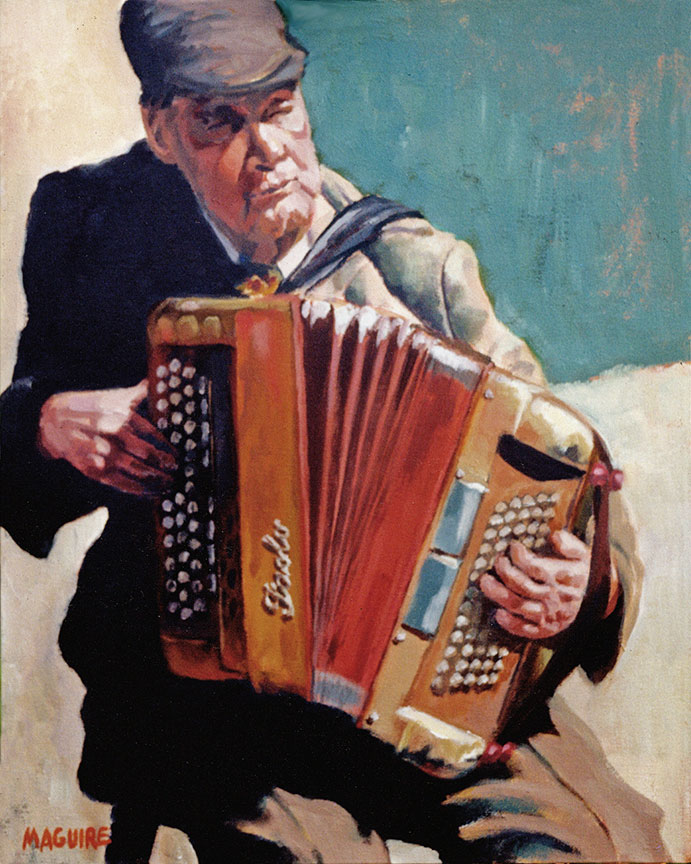
Barrie Maguire

(http://www.maguiregallery.com/barrie/images/accordian.jpg)

Louis Le Brocquy

(http://www.upenn.edu/ARG/archive/irish/irish.html)

Sean Keating

(http://www.upenn.edu/ARG/archive/irish/irish.html)


Sligo...

Galway...

Clare...

Jeremy's Find

1 picture from each county in the following order: Sligo, Galway, Clare


Recipe for Irish Stew:

Irish Stew HT MC Irish 150mins

Serve 4-6 Hot Lamb Vegetables Main Course Dairy Gluten Wheat Free British Ireland Europe

Ingredients

900g/2lb Best End Neck of Lamb *

2 Large Onions, sliced

2 large Carrots, thickly sliced

675g/1-1/2lb Potatoes, peeled and thickly sliced

450ml/15 fl.oz. Good Fresh Stock

Salt and Pepper

A sprig each of Parsley and Thyme (optional)

Instructions

1. Cut the meat into even sized pieces and put into a large saucepan with the sliced onions, carrots and half the sliced potatoes. Add the stock, herbs (is using) salt and pepper.

2.Bring to the boil, remove any scum which surfaces, then cover and simmer for 1 hour 20 minutes. If using mutton, cook for 2 hours.

3. Add the remaining potatoes and continue to cook for a further 40 minutes.

4. To serve - taste and re-season if necessary, transfer to a hot serving dish and serve very hot.

This dish can also be cooked in the oven 150C, 300F, Gas mark 2 for 3 hours, but then it wouldn't be a stew it would be a casserole!


* You can also use mutton which is more traditional or lamb chops


Irish song about a place:

Cliffs of Doneen

You may travel far far from your own native land

Far away o'er the mountains, far away o'er the foam

But of all the fine places that I've ever been

Sure there's none can compare with the cliffs of Doneen.

Take a view o'er the mountains, fine sights you'll see there

You'll see the high rocky mountains o'er the west coast of Clare

Oh the town of Kilkee and Kilrush can be seen

From the high rocky slopes round the cliffs of Doneen.

It's a nice place to be on a fine summer's day

Watching all the wild flowers that ne'er do decay

Oh the hares and lofty pheasants are plain to be seen

Making homes for their young round the cliffs of Doneen.

Fare thee well to Doneen, fare thee well for a while

And to all the kind people I'm leaving behind

To the streams and the meadows where late I have been

And the high rocky slopes round the cliffs of Doneen.


Traditional Irish Song with English Translation:

Báidín Fheidhlimidh

Báidín Fheidhlimidh d'imigh go Gabhla,
Báidín Fheidhlimidh 's Feidhlimidh ann
Báidín Fheidhlimidh d'imigh go Gabhla,
Báidín Fheidhlimidh 's Feidhlimidh ann

Curfá:
Báidín bídeach, Báidín beosach,
Báidín bóidheach, Báidín Fheidhlimidh,
Báidín díreach, Báidín deontach,
Báidín Fheidhlimidh 's Feidhlimidh ann

Báidín Fheidhlimidh d'imigh go Toraigh,
Báidín Fheidhlimidh 's Feidhlimidh ann
Báidín Fheidhlimidh d'imigh go Toraigh,
Báidín Fheidhlimidh 's Feidhlimidh ann

Báidín Fheidhlimidh briseadh i dToraigh í,
Báidín Fheidhlimidh 's Feidhlimidh ann
Báidín Fheidhlimidh briseadh i dToraigh í,
Báidín Fheidhlimidh 's Feidhlimidh ann

--//--

Feidhlim's little boat went to Gola,
Feidhlim's little boat and Feidhlim in it,
Feidhlim's little boat went to Gola,
Feidhlim's little boat and Feidhlim in it

Chorus:
A tiny little boat, a lively little boat,
A foolish little boat, Feidhlim's little boat,
A straight little boat, a willing little boat,
Feidhlim's little boat and Feidhlim in it.

Feidhlim's little boat went to Tory,
Feidhlim's little boat and Feidhlim in it,
Feidhlim's little boat went to Tory,
Feidhlim's little boat and Feidhlim in it.

Feidhlim's little boat crashed on Tory,
Feidhlim's little boat and Feidhlim in it,
Feidhlim's little boat crashed on Tory,
Feidhlim's little boat and Feidhlim in it,

Monday, February 5, 2007

Scavenger Hunt

3 Images of Irish Counties (1 of county sligo, 1 of county galway, and 1 of county clare)

3 images of Irish Art


1 song in Eng. containing referance to a city in Ireland

Flogging Molly Lyrics

The Rare Ould Times Lyrics


[Originally by Pete St. John]

Rai
sed on songs and stories, heroes of renown
The passing tales and glo
ries that once was Dublin Town
The hallowed halls and houses, the
haunting children's rhymes
That once was part of Dublin in the rare ould times


Ring a ring a rosey, as the light declines
I r
emember Dublin City in the rare ould times

We
ll, my name it is Sean Dempsey, as Dublin as can be
Born hard and late in Pimlico, in a house that ceased to be
By trade I was a cooper, lost out to redundancy
Like my house that fell to progress, my trade's a memory

And I courted Peggy Dignam, as pretty as you please
A rogue and child of Mary, from the rebel Liberties
I lost her to a student chap, with skin as black as coal
When he took her off to Birmingham, she took away m
y soul

Ring a ring a rosey, as the light declines
I remember Dublin City in the rare ould times

The years have made me bitter, the gargle dims me brain
Cause Dublin keeps on changing, and nothing seems the same
The Pillar and the Met have gone, the Royal long since pulled down
As the grey unyielding concrete, makes a city of my town

Ring a ring a rosey, as the light declines
I remember Dublin City in the rare ould times

Fare thee well sweet Anna Liffey, I can no longer stay
And watch the new glass cages, that spring up along the quay
My mind's too full
of memories, too old to hear new chimes
I'm part of what was Dublin, in the rare ould times

Ring a ring a rosey, as the light declines
I remember Dublin City in the rare ould times

Ring a ring a rosey, as the light declines
I remember Dublin City in the rare ould times

3 images of traditional Irish food


Virtual Scavenger Hunt

Virtual Scavenger hunt: assignment for Tuesday 2.13

Please choose 4 of the following 7 items by next Tuesday’s class. When you have located those 4 items, please upload all 4 within a single post to the blog, heading it with your screen-name and the word “finds”; e.g., “Paddy mac Paddy – Finds”

1 recipe for a traditional Irish dish; recipe may not include any ingredients not available in rural settings

3 images of different Irish traditional foods

1 song in Irish with English translation

3 images of Irish art (painting or sculpture only) depicting traditional topics (music, dance, song, foodways, storytelling, etc)

1 song in English which makes specific reference to the Irish Diaspora

1 song in English which makes specific reference to a specific place (town, village, parish, or geological formation) in Ireland

3 images, 1 each of Counties Sligo, Galway, and Clare

Wednesday, January 31, 2007

Next readings (certainly by Tues Feb 6)

Readings Packet: Short poems in the Hoagland-edited excerpts

Two of these are pre-Christian pagan poems: both “Amergin” and “From the Triads of Ireland” exemplify Irish approaches to imagery, nature references, poetic structure, and the art of the memory; the balance are early-Christian poems. What are these approaches: to imagery, nature, structure, and the memory? How would you specifically describe Irish approaches in these poems? The Christian poems are from the same period (and some of the same people) of the peregrini: the Christian monks, clerics, and scholars who went back to Europe after the Fall of Rome, founded monasteries, libraries, and universities, and preserved the link with ancient Greek and early Christian learning. These are also the same people who created the music on the Altramar Celtic Wanderers CD (which we’ll listen to).

Readings Packet: Glassie “Introduction: At the End of a Short Winter’s Day” and “Preface”

In the “Introduction,” Glassie links history and folklore, giving a narrative of both the formal collection and study of folk-tales, and through this narrative some ideas about how history and folklore might intersect and combine. What does Glassie believe are the strengths and limitations of each of these fields? What does he see as the strength of the approach of “folk” historians like Hugh Nolan? What does Hugh Nolan or Michael Boyle bring to the study and the narrative of history that Glassie sees as lacking in the more academic works?

In the “Preface,” Glassie both summarizes a period of Irish history (roughly from St Patrick to the 19th century), with a specific focus on the ways in which the Irish have told themselves their own histories. Why do you think Glassie put this information here, along with his Acknowledgements to those who helped him put the book together? Do you think he perceives a link between the acknowledgement of those who through history preserved the folklore, and those who helped him with this book? Further to a question we’ve asked earlier: what is the historian’s responsibility to his/her own community?

Reading Packet: Glassie, "Hugh Nolan: I'll Tell You the Way It Was."
This is a short summary of the role of the "mummer's plays" (seasonal folk plays, staged in people's rural kitchens in the shortest days of the winter, with a cast of historical characters including St Patrick, St George, Oliver Cromwell, and various mythological characters as well). Read the description, see what Hugh Nolan and Glassie both have to say about the meaning and social function of the mummer's play, and then read the play's text, linked on WebCT at "Course Menu - Mummer's Play." Try reading the poetic lines aloud and see if you can figure out the appropriate timing to make the lines really swing.

Carson LNF “The Humours of Whiskey”

This is a beautiful, very complicated chapter which brings up a whole series of folkways and their interaction: food, drink, oral lore (as in “how to make or buy poitin”), names and language, and the relations between rural people (Aran Islanders) and urban folklorists (John Millington Synge, excerpts of whose fieldnotes we’ll read). Think about the following questions:

Why does Carson spend this long section talking, essentially, about booze? Surely he’s not buying into the old “Irish are drunks” trope? Hint: what does he think the power or symbolism of poitin might be?

[ALSO]
Reading Packet: Glassie, "Hugh Nolan: I'll Tell You the Way It Was."
This is a short summary of the role of the "mummer's plays" (seasonal folk plays, staged in people's rural kitchens in the shortest days of the winter, with a cast of historical characters including St Patrick, St George, Oliver Cromwell, and various mythological characters as well). Read the description, see what Hugh Nolan and Glassie both have to say about the meaning and social function of the mummer's play, and then read the play's text, linked on WebCT at "Course Menu - Mummer's Play." Try reading the poetic lines aloud and see if you can figure out the appropriate timing to make the lines really swing.

Thursday, January 25, 2007

Next readings and Discussion Ideas

Glassie: Ch. 5 “Late Harvest”

This chapter introduces Michael Boyle, one of Glassie’s principle informants and the leader of the mummers’ play (folk-drama) we will enact later in the semester; he also talks about “talent,” “excellence,” “reciprocity,” and the responsibility of the artist to the community and of members of the community to one another. What are the roles and the responsibilities of those with talents in certain areas? What do they owe to other community members? Why does Glassie use the term “reciprocity” to describe these complex networks of obligation?

Glassie PTT: Ch. 6 “Sacred Beginnings” and Ch. 12 “Plans and Snags” (both short)

In Chapter 6 Glassie transcribes and describes a number of sacred phenomena: stories, biographies, specific places, and specific “cures.” What is the relationship between history and such “sacred lore”? Does a close familiarity with such lore help people in Ballymenone make sense of their own lives and identities? Can you compare the degree of detailed “local knowledge” held by the people of Ballymenone, versus that held by people who live, say in a city apartment building? What else is lost when one loses “local/nature knowledge”? Does this sense of “the sacred in history and in nature” change how Ballymenone people relate to the natural world?

In Chapter 12 Glassie lets the people’s words articulate their own sense of the “meaning of life”: why humans are put on earth and how they can make sense of life’s seeming contradictions. Based on this chapter, how would you summarize Ballymenone’s “cosmology” (understanding of the world)? Be prepared to articulate this in class discussion.

Carson LNF “Hard to Fill” (and, if you wish, going on to the next chapter, “The Steampacket”)

This chapter is (mostly) about Carson’s own instrument, the flute, the various flutes he’s played, how he learned to play, and the whole lore and mystique that surrounds specific instruments. Note the almost obsessive (but wonderfully evocative) description of the flute-maker’s shop and its contents, and likewise the description of the subtle playing differences between various flutes. Why do you think Carson includes such detail? Is there a relationship between description of construction details and the kinds of details that musicians deal with? What is that relationship? Do you think Carson believes that knowing the visual details of the shop will somehow help us-the-reader understand the sonic details of the music? What kind of playing/listening experience might such attention yield? (Hint: ask me in class regarding Tommy Potts’s quote about “the Hidden Note”).

No readings in Ó hAllmhuráin for this section